DEMO / Commerce
Commerce Lab · Transaction workspace
A concept study of orders, inventory and refund boundaries. It is a design proposal rather than a client delivery.
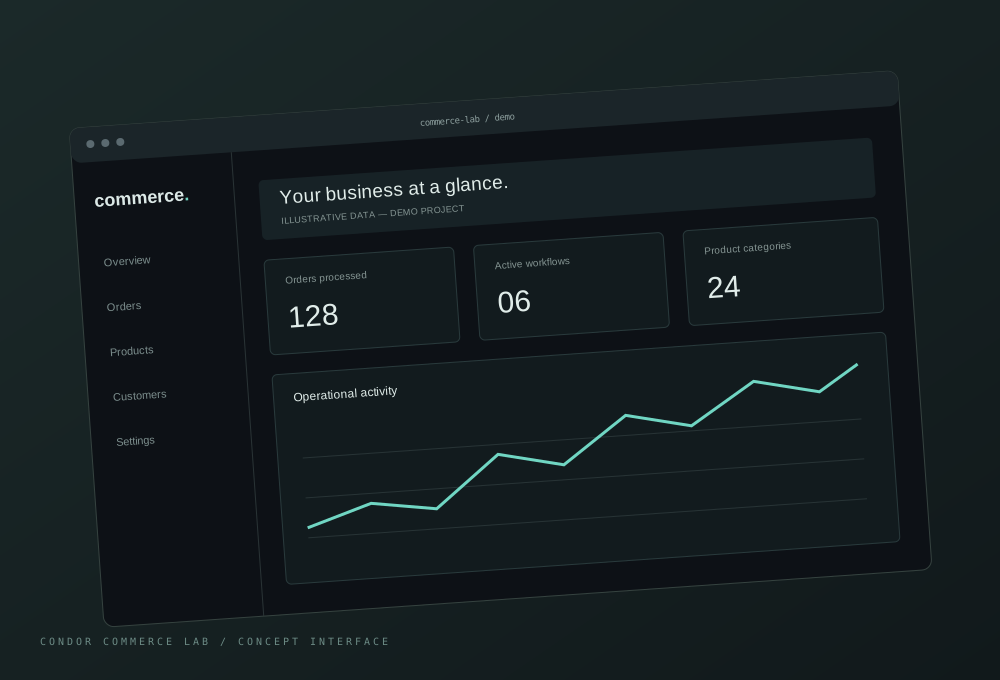
Concept demo: the SVG cover and design discussion are illustrative. They are not evidence of a client project, shipped features or verified performance.
Background
A concept proposal for discussing ownership across orders, payments and fulfillment, without a client system.
Challenges
- Keep orders, stock and amounts aligned when callbacks repeat, operators act concurrently or refunds cover only part of a purchase.
Solution
Agree on authoritative records and transitions, then evaluate idempotency, transactions, recovery and audit trails against real integration contracts.
Capabilities and scope
- Proposed: separate order and payment states
- Proposed: idempotent callback handling
- Proposed: refund and audit reconciliation
Architecture
Concept layers: a Vue operations interface, Laravel APIs, MySQL state records and Redis coordination. No running implementation or capacity evidence is supplied.
Results and evidence
- A concept design and acceptance questions are documented
- No live provider integration, client delivery or production performance is established
What the study is for
A transaction screen can hide several independent facts behind a single “complete” label. This study proposes a clearer separation between an order, a payment and fulfillment so an operator can understand the effect of an action and an engineer can judge whether a request is safe to repeat.
The cover is an illustration, not an interactive application. Nothing here represents a delivered client system, a live payment integration or measured operational results.
Follow the authoritative record
An order expresses a purchase intention. A payment records what a provider reports. Fulfillment records what was delivered. They are related, but one status field should not stand in for all three. Multiple payment attempts and partial refunds make that distinction especially important.
Amount handling needs an agreed currency, precision, discount allocation and refund source. A value formatted for the browser must not become the server's settlement authority. Historical amounts and later corrections should remain explainable.
Repeated callbacks should not repeat fulfillment
A proposed implementation would authenticate the callback and use the provider's transaction identity to recognize repeats. The idempotency rule must follow the actual provider contract, rather than depend only on a short-lived cache. Transaction scope, asynchronous dispatch and recovery ownership belong in the integration notes.
Acceptance cases should resend the same valid callback and inspect the resulting fulfillment record. Late callbacks, mismatched amounts and unknown orders need separate cases. Real provider behavior remains unverified until sandbox access is available.
Make operator actions explicit
Closing, canceling, refunding and retrying are different actions. Each should explain the required state, permission and consequence. A blocked action needs a useful reason, while the server still enforces the rule independently of the interface.
An audit record should identify the actor, target, action and outcome without exposing credentials or payment details. Search, exports and reports must respect the same access boundaries as the detail page.
Turn the proposal into evidence
- Agree on states, roles and amounts using representative business examples.
- Write failure cases for repeated requests, stock contention and partial refunds.
- Implement one complete transaction path in an isolated environment and keep the check results.
- Integrate with a real provider sandbox before agreeing on release and rollback.
Database, queue and cache choices still need deployment-specific evaluation. This study provides no throughput claim. If an agent may assist an operator, the related Agent Workbench study adds a discussion of approvals and tool permissions.